


A Complete Guide to Heat Pump Types, Efficiency, and Applications
Heat pumps are rapidly becoming a cornerstone of modern plumbing, hydronic heating, and HVAC design. As electrification accelerates across North America, contractors, builders, and homeowners are increasingly turning to heat pumps for their exceptional efficiency, versatility, and reduced environmental impact.
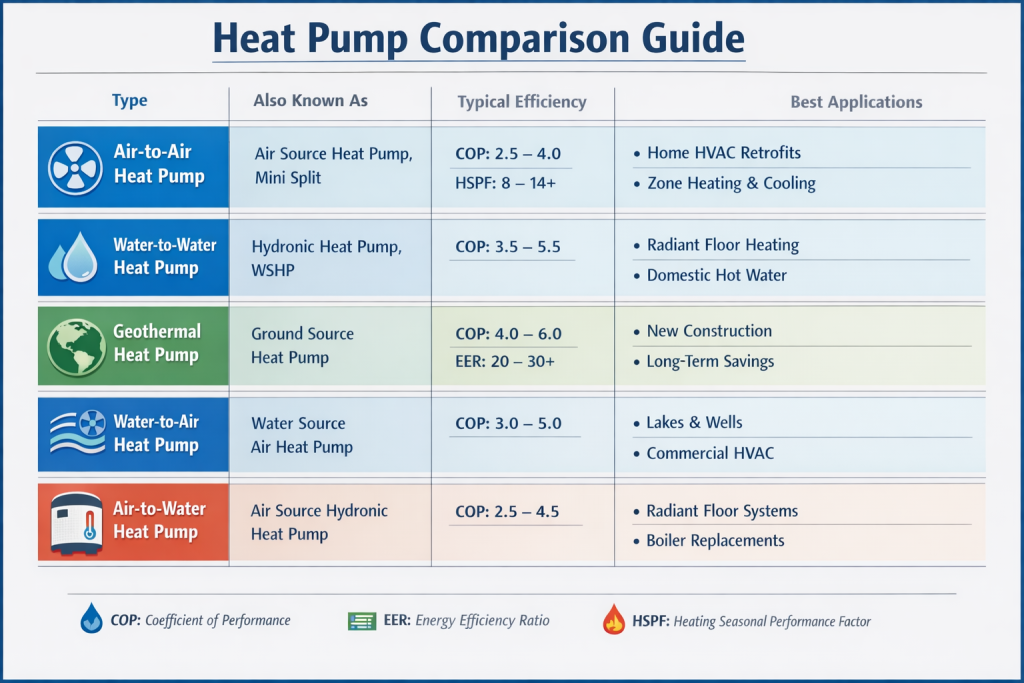
Unlike traditional heating systems that generate heat, heat pumps move heat from one place to another, making them dramatically more efficient than fossil-fuel or electric resistance systems. In this guide, we’ll explore the five most common heat pump types used in residential and light commercial applications, including what they’re called in the field, how efficient they typically are, and where they perform best.
🌬️ Air-to-Air Heat Pumps
(Air Source Heat Pumps / Mini-Splits)
Also known as:
Air Source Heat Pump (ASHP), Mini-Split, Multi-Split, Ducted Heat Pump, Variable-Speed Heat Pump
Air-to-Air heat pumps extract heat from the outdoor air and deliver it directly into the building as warm air. In cooling mode, the process reverses, making these systems function similarly to high-efficiency air conditioners. Modern cold-climate air-source heat pumps can operate effectively even in sub-freezing temperatures, making them viable across most of Canada and the northern United States.
These systems are commonly installed as ductless mini-splits and minimize the presence of ducts and diffusers in a building. This reduces the amount of sheet metal work in a building, but reduces the even distribution of warm air delivery
Typical Efficiency
- COP: 2.5 – 4.0
- HSPF: 8 – 14+
- Seasonal efficiency: 200% – 400%
Best Applications
- Homes without existing hydronic systems
- Retrofit projects replacing furnaces or baseboard heaters
- Zone heating and cooling in renovations and additions
- Mild to cold climates with modern cold-climate models
💧 Water-to-Water Heat Pumps
(Hydronic Heat Pumps)
Also known as:
Water Source Heat Pump (WSHP), Hydronic Heat Pump, Liquid-to-Liquid Heat Pump
Water-to-Water heat pumps are a natural fit for hydronic heating professionals. These systems move heat between water loops, such as from a ground loop, well, or boiler return and deliver heated (or chilled) water to radiant floors, fan coils, buffer tanks, or domestic hot water storage.
Because water is a more stable and efficient heat transfer medium than air, water-to-water systems often outperform air-source heat pumps in overall efficiency. They are especially popular in commercial buildings, multi-unit residential projects, and high-performance homes where hydronic distribution is already planned or installed.
Typical Efficiency
- COP: 3.5 – 5.5
- Seasonal efficiency: 350% – 550%
Best Applications
- Radiant floor heating systems
- Snow melt and slab heating
- Domestic hot water pre-heating or full DHW production
- Commercial hydronic loops and multi-family buildings
🌎 Geothermal Heat Pumps
(Ground-Source Heat Pumps)
Also known as:
Ground Source Heat Pump (GSHP), GeoExchange®, Ground Loop System
Geothermal heat pumps use the earth as a heat source in winter and a heat sink in summer. By tapping into stable underground temperatures through vertical or horizontal ground loops or submerged open lake loops. These systems deliver the highest efficiency of any heat pump technology.
Geothermal systems can be configured as water-to-water or water-to-air, making them extremely flexible for both hydronic and forced-air designs. While upfront installation costs are higher due to drilling or excavation, the long service life, low operating costs, and stable performance make geothermal a top choice for long-term investments.
Typical Efficiency
- COP: 4.0 – 6.0+
- EER: 20 – 30+
- Seasonal efficiency: 400% – 600%+
Best Applications
- New construction with available land
- High-end residential and institutional buildings
- Facilities prioritizing long-term energy savings
- Cold climates with high heating demand
💦 Water-to-Air Heat Pumps
Also known as:
Fan Coil Heat Pump, Vertical Stacked Heat Pump
Water-to-Air heat pumps are used in commercial buildings to extract heat from a heated or chilled water loop and deliver it as heated or cooled air through a diffuser These systems combine the efficiency advantages of water-based heat exchange with the familiarity of forced-air distribution.
They are commonly found in commercial buildings and waterfront properties, where water temperatures remain relatively stable year-round. Compared to air-source systems, water-to-air heat pumps experience less performance drop during extreme weather.
Typical Efficiency
- COP: 3.0 – 5.0
- EER: 15 – 25
- Seasonal efficiency: 300% – 500%
Best Applications
- Commercial HVAC systems with shared water loops
- Homes where ducted air delivery is preferred
- Mixed-use buildings with centralized mechanical systems
🌀 Air-to-Water Heat Pumps
(Air Source Hydronic Heat Pumps)
Also known as:
Air-to-Hydronic Heat Pump, Air Source Water Heater, Monobloc or Split Hydronic Heat Pump
Air-to-Water heat pumps bridge the gap between traditional boilers and modern electrification. They extract heat from outdoor air and deliver hot water for space heating, radiant floors, panel radiators, fan coils, and domestic hot water.
These systems are rapidly gaining popularity in both Canada and the U.S. as a boiler replacement solution. When paired with buffer tanks and low-temperature distribution systems, air-to-water heat pumps can deliver excellent performance even in cold climates.
Typical Efficiency
- COP: 2.5 – 4.5
- Seasonal efficiency: 250% – 450%
Best Applications
- Hydronic retrofits replacing oil or gas boilers
- Radiant floor and panel radiator systems
- Domestic hot water production
- Electrification and net-zero building projects
🌱 Why Heat Pump Efficiency Matters
A heat pump with a COP of 4.0 produces four units of heat for every unit of electricity consumed. This efficiency reduces energy costs, lowers carbon emissions, and future-proofs buildings against fossil-fuel volatility—especially when paired with renewable electricity sources.
🌍 Heat Pump Advocacy & Nonprofit Organizations
(Canada & United States)
If you want to stay informed, trained, or involved in the transition to clean heating, these organizations play a major role across North America:
Binational & North American
- International Ground Source Heat Pump Association (IGSHPA) – Education, standards, and advocacy for geothermal heat pumps
- ASHRAE – Develops standards and research for HVAC and heat pump performance
- RMI (Rocky Mountain Institute) – Leading nonprofit advancing electrification and heat pump adoption
Canada-Focused
- Canadian GeoExchange Coalition (CGC) – National voice for geothermal heat pump technology
- Efficiency Canada – Policy research organization supporting clean energy transitions
- Clean Energy Canada – Advocates for electrification and zero-emission buildings
United States-Focused
- Geothermal Exchange Organization (GEO) – U.S. geothermal heat pump advocacy
- Rewiring America – Promotes electrification and heat pump adoption at the household level
- ACEEE (American Council for an Energy-Efficient Economy) – Research and policy support for efficient heating technologies
🔧 Final Takeaway
From air-source mini-splits to high-efficiency geothermal systems, heat pumps now cover nearly every residential and commercial heating application. For plumbing and hydronic professionals, understanding the differences, efficiencies, and use cases of each type is essential to designing modern, future-ready systems.